

Stair/Lobby
Explore our complete collection of museum-quality canvas art. Each piece is printed on premium 340gsm cotton canvas with archival inks.
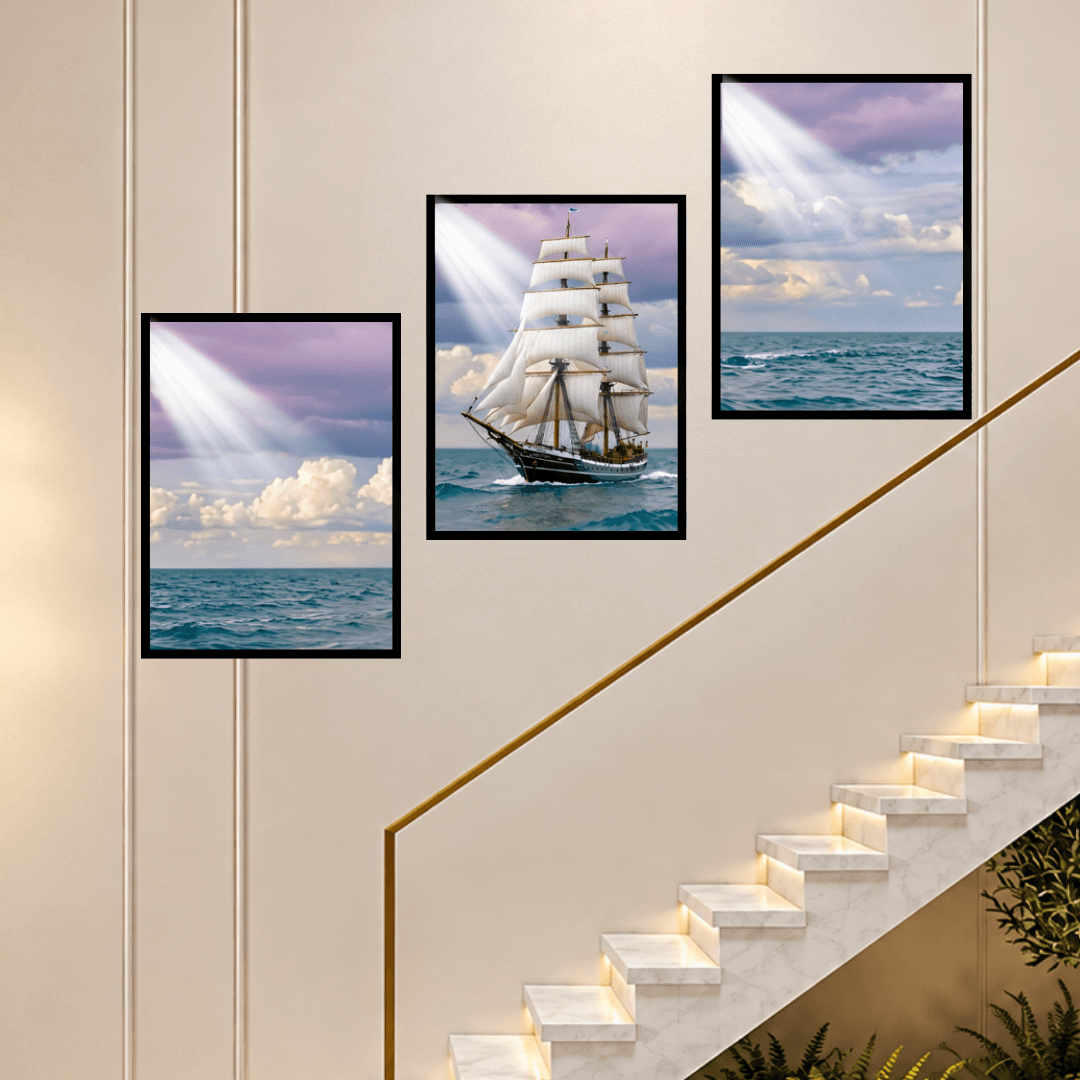

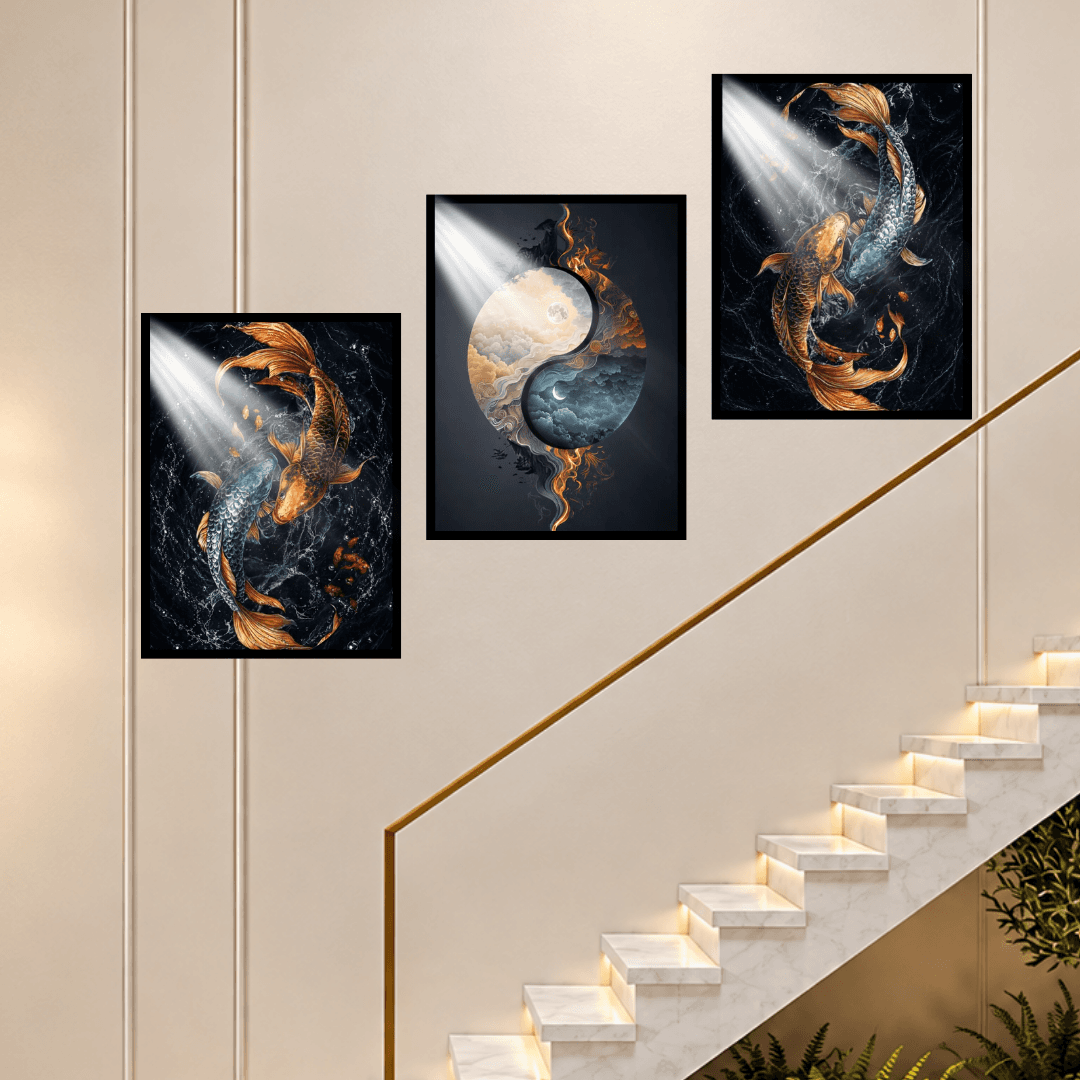
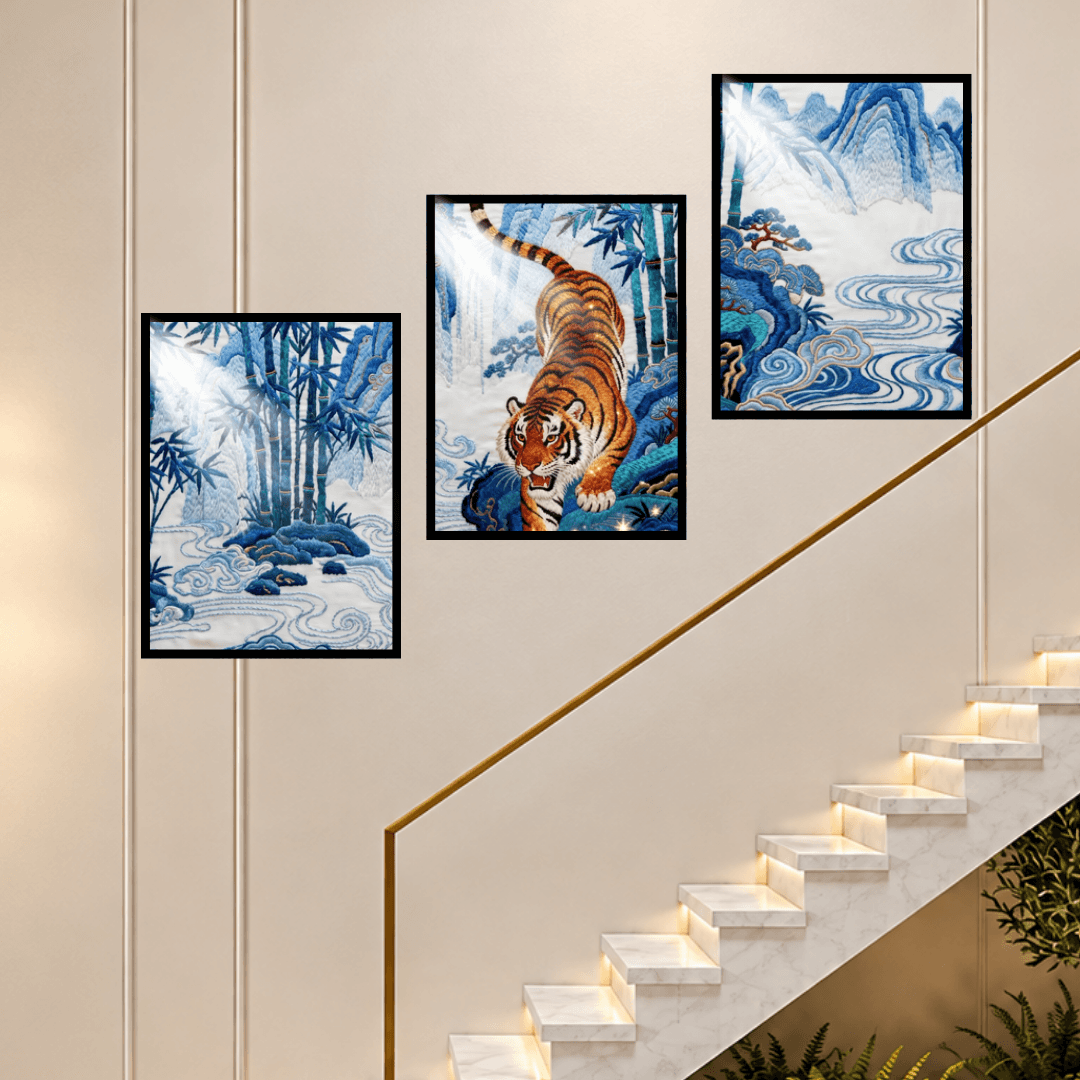
Stairs, entryways, and hallways are the parts of a home everyone passes through and almost no one stops in. Art in these spaces has to make its point quickly, often from below, from a distance, or while someone is on the move. This collection brings together decor designs suited to stair walls, landings, and entrance lobbies, including wide 3-piece sets that hold their own on large, open walls. Each design is UV-printed on the back of a clear acrylic panel for a glossy, mirror-like depth.
Why Stair and Entry Walls Need Different Art
In a living room you sit and look. On a staircase you climb, turn, and glance. That single difference changes what works. Fine detail that rewards a long look in the living room is mostly lost on a stair wall, because nobody stands still long enough to notice it. What reads well instead is a strong, simple composition: a clear horizon, a single bold subject, a shape you can take in within a second or two.
The viewing angle matters just as much. Art on a stair wall is seen from below as you go up and from above as you come down, and art in an entry lobby is often first seen from the doorway, several meters away. Pieces that look balanced when you stand right in front of them can feel small and lost from those positions. So for these spaces it usually pays to go a size larger, or to choose a multi-panel set, than you would for a wall of the same width inside a room.
|
Location |
How people see it |
What tends to work |
|---|---|---|
|
Stair wall |
In motion, from below and above |
Single pieces that step up with the stairs; bold, simple images |
|
Landing |
Head-on while climbing, with a brief pause |
A wide 3-piece set hung level, or one large statement piece |
|
Hallway |
Up close, while walking past |
A row of modest pieces at one consistent height |
|
Entrance lobby / foyer |
From the doorway, then up close |
A focal piece with presence; larger sets for tall foyers |
How to Hang Art Along a Staircase
The most common mistake on stair walls is hanging pieces at one fixed height, as if the wall were flat. Halfway up the stairs, art that looked right from the bottom step ends up at knee level or far overhead. The art needs to rise with the steps, so that it stays at a comfortable height for someone actually using the stairs.
One practical way to get this right:
- Decide where each piece will go along the wall, and mark the step directly below the center of each one.
- For each piece, measure up from the front edge of that step to the point where the center of the art should be. Use the same measurement every time, so the pieces climb in a line roughly parallel to the handrail.
- Keep the spacing between pieces equal along the slope rather than along the floor. Your eye follows the diagonal, so that is the spacing it notices.
- Tape paper templates in place first and walk the stairs in both directions before committing to any nails.
There is a catch with 3-piece sets. Many of them, such as Journey Across Oceans, carry a single image across all three panels. Stagger those panels diagonally up the stairs and the horizon breaks into steps, which can look like a mistake rather than a choice. A set like that is usually happiest hung level, on a landing or a flat section of wall, where the image can run straight across as intended. If you want art that follows the slope itself, separate single pieces are easier to arrange.
Landings, Hallways, and Entrance Lobbies
Not every part of this circulation space behaves the same way. The landing is often the best wall in the whole stairwell: it faces you as you climb, you pause there to turn, and it is usually flat and wide enough for a full 3-piece set. If you only hang one significant piece on the stairs, the landing is a strong candidate.
Hallways are the opposite. They are narrow, so you can never step back far enough to see a large piece whole, and anything that sticks out risks being brushed by shoulders and bags. Here, a series of modest pieces at a consistent height tends to work better than one oversized statement, and it gives the corridor a sense of rhythm as you walk along it.
The entrance lobby, or the first wall you see when the front door opens, sets the tone for the whole house. It is the one spot in these spaces where people do pause, to take off shoes, find keys, or greet guests. That makes it a good home for a piece with presence. In homes with a tall, double-height foyer, the scale of the wall can swallow anything small, and a wide set like Azure Mountain Tiger gives the space a focal point that matches its height.
Safety on Stairs: A Few Things Worth Taking Seriously
Hanging art over a staircase is one of the few decorating jobs that carries real risk, mainly to the person doing it. Leaning out from a step with a hammer, or balancing a household ladder on uneven stairs, is how accidents happen. Use a ladder designed for stairs or one that sits firmly on a landing, have someone hold it, and if a spot cannot be reached safely, choose a different spot.
Once the art is up, think about the people using the stairs every day. Keep frames clear of the handrail side and out of the path of shoulders, especially on narrow stairways. Each piece comes with a plastic wall hook and nail and uses a lightweight composite frame, but how firmly a hook holds depends on the wall behind it, so check whether you are fixing into concrete, plywood, or drywall and use hardware suited to it. A piece falling onto a staircase is a hazard in a way that a piece falling behind a sofa is not.
Light, Reflections, and the View From the Steps
Stairwells are often lit by a single ceiling fixture or by a window on the landing, and both create strong, directional light. Because the acrylic face is glossy, it can catch that light as a bright patch, and on stairs the problem moves with you: a reflection that is invisible from the bottom may appear halfway up. Before fixing anything in place, hold a paper template or a small mirror at the planned spot and check it from several steps on the way up and the way down, during the day and with the lights on at night. Shifting the position slightly, or angling a fixture, usually solves it.
Choosing a Theme for the First Wall Guests See
Because the entrance is where visitors form their first impression, many families choose imagery here with care. Some prefer something welcoming and open, like a seascape that draws the eye outward. Others choose motifs with traditional meanings: Koi Yin Yang Harmony pairs koi with the yin-yang symbol, associated with balance, and tigers are often linked with strength and protection, which is one reason they appear in entryways. These are symbolic choices, not promises of any outcome, so the best one is the motif whose meaning genuinely speaks to your household. You can explore more in our feng shui art collection.
If you are decorating the lobby of a business rather than a home, such as a hotel, clinic, or office reception, our wall art by space collections, including hotel and resort and office designs, are a better starting point.
Want a Second Opinion on Your Stair Wall?
Send a photo of the staircase or entry wall, taken from the bottom step or the doorway, along with rough measurements, through our contact page. We can suggest designs and sizes that suit the space. For other parts of the home, browse all our wall art by room.